
AmazingBuyz is reader-supported. When you buy through links on our site, we may earn an affiliate commission at no extra cost to you. Learn more.
The best baby carriers free up your hands while keeping your baby snug against you, which is a lifesaver for fussy evenings, airport lines and holiday crowds. We compared specs, expert testing and owner reviews to pick the baby carriers worth buying in 2026, from stretchy newborn wraps to structured carriers that last into the toddler years and a framed pack for the trail.
Part of our Baby & Kids Buying Guides.

Quick picks
| Product | Best for | Price range | |
|---|---|---|---|
| BabyBjörn Baby Carrier Harmony | Best overall comfort | $$$ | See price |
| Ergobaby Omni Deluxe Baby Carrier | Every carry position | $$$ | See price |
| BabyBjörn Baby Carrier Mini | Newborns | $$ | See price |
| Tula Free-to-Grow Baby Carrier | Long-term use | $$$ | See price |
| Solly Baby Wrap | Stretchy newborn wrap | $$ | See price |
| Baby K’tan Original Baby Wrap Carrier | Easiest wrap | $$ | See price |
| Nalakai Ring Sling | Quick ups and hip carries | $$ | See price |
| Osprey Poco LT Child Carrier | Hiking | $$$$ | See price |
| Infantino Flip 4-in-1 Convertible Carrier | Budget pick | $ | See price |
Price ranges: $ under $50, $$ $50–$150, $$$ $150–$250, $$$$ $250+. Prices change often, so check the current price on Amazon.
1. BabyBjörn Baby Carrier Harmony: Best Overall
The Harmony is BabyBjörn’s top carrier, and it’s built for parents who wear their baby for long stretches. The airy 3D mesh keeps both of you cooler, the padded lumbar support spreads weight onto your hips, and the adjustable seat grows from newborn to toddler across three carry positions. It’s also light and machine washable.
Key specs
- Child weight: 7–40 lb
- Positions: facing in from birth, facing out from about 5 months, back carry from about 12 months
- Carrier weight: about 1.5 lb
- 3D mesh (or woven cotton-blend version)
- Hip-healthy acknowledged by the International Hip Dysplasia Institute (IHDI)
- Adjustable seat width; machine washable
👍 Pros
|
👎 Cons
|
What owners say: Owners consistently praise the back support, even weight distribution and cool mesh fabric. A short learning curve with the straps is the most common complaint.
2. Ergobaby Omni Deluxe Baby Carrier: Best All-Position Carrier
Ergobaby’s flagship covers every carry position (front facing in, front facing out, hip and back) from newborn to preschooler without a separate infant insert. The mesh version is designed to run cooler than Ergobaby’s cotton models, and the waist belt and pockets make it practical for full days out.
Key specs
- Child weight: 7–45 lb (0–48 months)
- Four positions; outward, hip and back carries from about 5–6 months
- No infant insert needed
- Deluxe mesh fabric
- Hip-healthy certified by IHDI
- Machine washable
👍 Pros
|
👎 Cons
|
What owners say: Parents like the supportive waistband and the pockets for phone and keys. Some mention a learning curve, and very tall wearers sometimes find the fit awkward.
3. BabyBjörn Baby Carrier Mini: Best for Newborns
The Mini is a simple, soft front carrier designed for the first months. It has very few buckles, so it’s easy to put on by yourself, and the front panel unfastens so you can lay a sleeping baby down without waking them. It’s a first carrier rather than one that lasts into toddlerhood.
Key specs
- Child weight: 7–24 lb (brand recommends it mainly for 0–6 months)
- Facing in from birth; facing out from 5 months
- Carrier weight: about 1.7 lb
- No waist belt
- IHDI hip-healthy; Oeko-Tex Standard 100 Class 1 fabric
👍 Pros
|
👎 Cons
|
What owners say: Owners love how secure and cozy it feels in the early weeks. Many say comfort drops once their baby gets heavier.
4. Tula Free-to-Grow Baby Carrier: Best for Long-Term Use
The Free-to-Grow uses an adjustable panel to fit babies from newborn to toddler without an insert. It’s made of soft, breathable cotton and includes a hood and a waistband pouch. It skips forward-facing in favor of a simpler front-inward and back-carry design that many parents find comfortable for years.
Key specs
- Child weight: 7–45 lb
- Two positions: front facing in and back carry
- 100% cotton
- No newborn insert needed
- Hood and waistband pouch
👍 Pros
|
👎 Cons
|
What owners say: Testers and parents find it comfortable and well made. The limited positions and less head support for very small babies are the common criticisms.
5. Solly Baby Wrap: Best Stretchy Wrap
The Solly is a long, lightweight wrap made from silky TENCEL modal. You tie it on, then tuck your newborn in for a snug, womb-like hold that’s ideal for the “fourth trimester.” Most families move to a structured carrier once their baby gets heavier.
Key specs
- Child weight: 8–25 lb
- Newborn hold and classic front-inward carry
- 100% TENCEL modal
- One size fits most wearers
- Built-in pocket
👍 Pros
|
👎 Cons
|
What owners say: Parents call it essential for the early weeks and easy to wash. The most common note is that it takes a few tries to tie correctly.
6. Baby K’tan Original Baby Wrap Carrier: Easiest Wrap
The K’tan gives you the snug feel of a wrap without the tying. It’s a pre-formed, two-loop cotton carrier that slips on over your head like a T-shirt, and it supports five carry positions. You buy it in your own size, so it isn’t easy to share between parents of different builds.
Key specs
- Rated from 8 lb (check the label for the maximum)
- Five positions, including hug, kangaroo and hip
- 100% cotton
- Sized to the wearer
- Machine washable and dryer safe
👍 Pros
|
👎 Cons
|
What owners say: Testers found it far easier than a traditional wrap, and many babies doze off in it quickly. It’s less comfortable for long wear because it has no padding.
7. Nalakai Ring Sling: Best Ring Sling
A ring sling is the quickest carrier for short trips: thread the fabric through two rings, tighten and go. Nalakai’s bamboo-linen sling is breathable, fits many body types and adjusts with a single pull, which makes it handy for nursing on the go and hip carries for older babies.
Key specs
- Child weight: 8–35 lb
- Facing-in carry; hip carry once baby has good head, neck and torso control
- 58% bamboo / 42% linen
- Tail pocket
- Machine wash cold, hang dry
👍 Pros
|
👎 Cons
|
What owners say: Testers liked how close it keeps the baby and how quickly they could adjust it alone. The open tail pocket can let small items slip out.
8. Osprey Poco LT Child Carrier: Best for Hiking
Once your child can sit up on their own, a framed backpack carrier makes trail days possible. The Poco LT is Osprey’s lighter model: it folds flat for the car, includes a built-in sunshade, and carries enough storage for a day hike while staying compact enough for city sidewalks.
Key specs
- Pack weight: 5 lb 9 oz
- Max load: 48.5 lb (child, gear and pack combined)
- 25 L of storage
- Folds flat; built-in sunshade
👍 Pros
|
👎 Cons
|
What owners say: Testers found it compact enough for busy streets yet roomy enough for a day on the trail. Taller hikers and those wanting more padding may prefer the full-size Poco.
9. Infantino Flip 4-in-1 Convertible Carrier: Best Budget
The Flip offers four carry positions and an adjustable seat for a fraction of what premium carriers cost. It’s a sensible pick for occasional errands or a backup carrier for a grandparent’s house, though it gets less comfortable as babies get heavier.
Key specs
- Child weight: 8–32 lb
- Four positions: facing in (narrow or wide seat), facing out and back carry
- Adjustable seat width and head support
- IHDI hip-healthy
- Machine washable; bib included
👍 Pros
|
👎 Cons
|
What owners say: Owners appreciate it as an inexpensive everyday carrier. Shoulder fatigue and limited support for bigger babies are the main complaints.
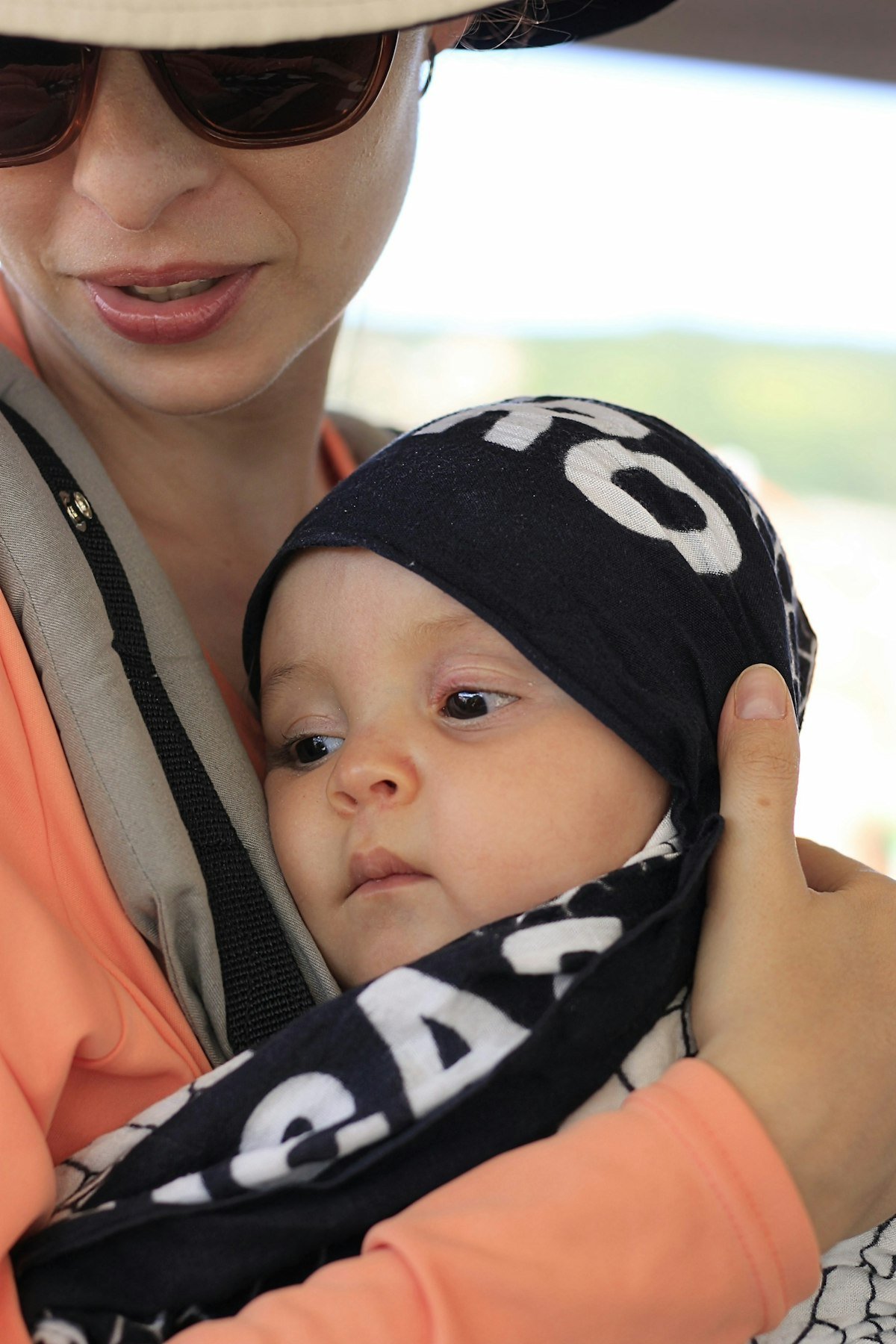
How to choose a baby carrier
- Carrier type: Stretchy wraps and pre-formed wraps are cozy for newborns; ring slings are fastest for quick carries; structured carriers offer the most support for longer wear and heavier babies; framed packs are for hiking.
- Weight range: Newborn-focused carriers often top out at 24–25 lb. If you want one carrier for years, look for 40–45 lb limits like the Harmony, Omni Deluxe or Tula.
- Carry positions: Decide whether you want forward-facing and back carries. Some excellent carriers skip forward-facing on purpose.
- Newborn fit: Check the minimum weight and whether an infant insert is needed. Many modern carriers fit from 7–8 lb without one.
- Hip-healthy design: Look for a wide seat that supports the thighs in an “M” position; several picks here are acknowledged by the International Hip Dysplasia Institute.
- Fabric and climate: Mesh breathes best in warm weather or heated stores; cotton is soft and durable.
- Ease of use: If you’ll often put it on alone, fewer buckles and front-reachable adjustments make a big difference.
FAQ
When can my baby face out in a carrier?
It depends on the carrier and your baby’s development, so follow the manufacturer’s limits. BabyBjörn’s Harmony and Mini allow facing out from about 5 months and the Ergobaby Omni Deluxe from about 5–6 months, once babies have good head control. Hip-health experts generally favor inward-facing carries in the first months.
What is the TICKS rule for safe babywearing?
TICKS stands for Tight, In view at all times, Close enough to kiss, Keep chin off chest, and Supported back. Your baby should be held snugly, with their face visible when you glance down, their head near your chin, a finger’s width of space under their chin and their back supported against you.
What makes a carrier “hip-healthy”?
A hip-healthy carrier supports your baby’s thighs in a spread-squat or “M” position, with knees slightly higher than the bottom. Look for a wide seat and, if it matters to you, an acknowledgment from the International Hip Dysplasia Institute.
When can my child ride in a hiking backpack carrier?
Framed backpack carriers are generally for children who can sit upright unassisted; REI suggests waiting until they also weigh more than 16 lb. Always check the carrier’s own minimums and maximum load.
Related guides
- The Best Travel Strollers
- The Best Infant Car Seats
- The Best Baby Monitors
- Colugo Baby Carrier 2 vs Ergobaby Omni Breeze: Which Wins?
- Colugo Baby Carrier 2 vs BabyBjorn Harmony: Which Carrier Wins?
- Baby & Kids Buying Guides
Sources
BabyGearLab: The Best Baby Carriers; Babylist: Best Baby Carriers of 2026; Mommyhood101: Best Baby Carriers of 2026; REI: The Best Kid Carriers of 2026; International Hip Dysplasia Institute: Baby Wearing; NHS Fife: The TICKS Rule; plus manufacturer specifications. Owner feedback is summarized in our own words from public reviews. Photos courtesy of Unsplash.
Pingback: Colugo Baby Carrier 2 vs Ergobaby Omni Breeze (2026)
Pingback: Colugo Baby Carrier 2 vs BabyBjorn Harmony (2026)