

AmazingBuyz is reader-supported. When you buy through links on our site, we may earn an affiliate commission at no extra cost to you. Learn more.
Coffee around the world is far more than one drink. It is an Ethiopian ceremony that fills an afternoon, a quick espresso at an Italian bar, a sweet iced glass in Vietnam and a cardamom-scented cup offered to guests in Saudi Arabia. This guide covers where coffee came from, what the major regions taste like, the traditions people built around it and how to brew it well at home.
Part of our Coffee Buying Guides.
On this page
- A short history of coffee
- Arabica vs Robusta
- Coffee regions and what they taste like
- Coffee traditions around the world
- How to brew coffee: 10 methods compared
- FAQ
- Related guides
- Sources

A short history of coffee
Ethiopia: where it began
Wild coffee is thought to have originated on the Kefa (Kaffa) plateau of Ethiopia, though Britannica notes the exact history is unclear.
The Kaldi legend. The best-known origin story is a legend, not documented history. A goatherd named Kaldi, sometimes placed around the 9th century, supposedly noticed his goats grew lively after eating the red cherries of a certain shrub. A local abbot brewed the cherries into a drink and found it kept him awake through evening prayers. It is a lovely tale, but nothing confirms Kaldi existed.
Yemen, Sufi monasteries and Mocha
Coffee crossed the Red Sea to southern Arabia and was being cultivated in Yemen by the 15th century. Tradition holds that Sufi mystics were among the first to brew it, using it to stay alert during nighttime devotions. Yemen’s port of Mocha became coffee’s main gateway to the world, which is why the word still appears on menus today.
The Ottoman coffeehouse
Coffeehouses called qahveh khaneh appeared in Mecca in the 15th century and in Constantinople (Istanbul) in the 16th. People gathered there to talk, trade news, hear music and play games, which earned them the nickname “Schools of the Wise.” Pilgrims and the expanding Ottoman Empire spread the habit far and wide.
Europe: Venice, London and Vienna
Venetian merchants brought coffee to Europe, and it reached Venice by the early 1600s. Some clergy reportedly denounced it as the “bitter invention of Satan,” until, as the often-told story goes, Pope Clement VIII tasted it and approved.
England’s first coffeehouse opened in Oxford in 1652, and London’s first opened that same year in St Michael’s Alley, Cornhill. A cup cost about a penny and the talk covered politics, science and trade, so London’s coffeehouses became known as “penny universities.” By 1739 London had more than 550 of them, and Lloyd’s of London began life in Edward Lloyd’s coffeehouse.
Vienna’s first coffeehouse opened in 1685. Locals like to say the habit started with sacks of beans left behind after the failed Ottoman siege of 1683, but that is a popular story rather than verified fact. UNESCO recognized Viennese coffeehouse culture as intangible heritage in 2011.
Java, the Caribbean and Latin America
In the 17th century the Dutch began growing coffee on Java, then Sumatra and Sulawesi, giving us the “Mocha Java” blend name. In 1714 the Mayor of Amsterdam gave a coffee tree to King Louis XIV of France. Around 1723, French naval officer Gabriel de Clieu carried a seedling from that line to Martinique. His own account says he shared his scant water ration with the plant and survived pirates and a storm, so treat the drama as story. The result is better documented: within about 50 years Martinique had millions of coffee trees, and their descendants spread across the Caribbean and Latin America.
Brazil’s start is pure legend. Around 1727, Portuguese officer Francisco de Melo Palheta is said to have received coffee hidden in a bouquet from a French governor’s wife. Whatever really happened, Brazil went on to dominate world production and today grows roughly a third of all coffee.
The American story
Coffee reached New York in the mid-1600s, but tea stayed popular until the 1773 tea tax and the Boston Tea Party. The National Coffee Association credits that revolt with turning Americans into coffee drinkers.
Instant coffee. Satori Kato developed a stable soluble powder around 1901, and George Constant Louis Washington mass-produced instant coffee in the US around 1910. Nescafé arrived around 1938, and freeze-drying in the 1960s improved the flavor.
Espresso. Luigi Bezzera patented an improved pressure machine in Italy in 1901. Then Achille Gaggia filed a 1938 patent for brewing with hot water pressure instead of steam, added a lever-piston patent in 1947 and began building lever machines in 1948. Those machines gave espresso its signature layer of crema.
The three waves. The first wave was coffee as an everyday commodity: canned grocery coffee, diner pots and instant. The second began with Peet’s Coffee & Tea in Berkeley in the late 1960s and spread through chains such as Starbucks, introducing dark roasts, named origins and espresso drinks. The third wave, a term popularized by roaster Trish Rothgeb in the early 2000s, focuses on single farms, lighter roasts and careful brewing. You can taste it in many shops from our guide to the best coffee roasters across the USA.
Coffee history timeline
| Year | Event |
|---|---|
| c. 850 (legend) | Kaldi the goatherd “discovers” coffee in Ethiopia |
| 1400s | Coffee cultivated in Yemen; coffeehouses in Mecca |
| 1500s | Coffeehouses open in Constantinople |
| Early 1600s | Coffee reaches Venice |
| 1652 | First coffeehouses in Oxford and London |
| 1685 | Vienna’s first coffeehouse |
| c. 1723 | De Clieu brings a seedling to Martinique |
| c. 1727 | Coffee reaches Brazil (Palheta story) |
| 1773 | Boston Tea Party pushes Americans toward coffee |
| 1828 | Coffee planted in Kona, Hawaii |
| 1908 | Melitta Bentz invents the paper filter |
| c. 1910 | Instant coffee mass-produced in the US |
| 1933 | Alfonso Bialetti’s moka pot |
| 1938 | Gaggia’s espresso patent; Nescafé launches |
| 1960s | Freeze-dried instant; second wave begins |
| 1969 | First canned coffee sold in Japan |
| 2005 | AeroPress launches |
Arabica vs Robusta
Arabica and robusta together make up more than 99% of commercially grown coffee, according to the National Coffee Association.
- Arabica (Coffea arabica): about 57% of world production. Grows at higher altitudes, roughly 2,000 to 6,000 feet, and tastes milder and more aromatic. Nearly all specialty single-origin coffee is arabica.
- Robusta (Coffea canephora): about 43% and rising. Hardier, grown at lower altitudes, with roughly 50 to 60% more caffeine. It tastes bolder and more bitter and shows up in instant coffee, blends and traditional Italian espresso blends.
Liberica and excelsa, two lesser-known species, are slowly gaining attention.
Coffee regions and what they taste like
Coffee grows in the “Bean Belt” between the Tropics of Cancer and Capricorn. Altitude, variety and especially processing shape the cup:
- Washed: fruit removed before drying; usually clean, bright, citrusy or floral.
- Natural: whole cherry dried around the bean; fuller body, sweet and fruity, sometimes wine-like.
- Honey: some sticky fruit left on during drying; sweetness between the two.
Africa
Ethiopia grows heirloom arabica at very high altitudes, mostly naturally processed, with floral, fruity and spicy flavors. Kenya brings full body, sharp fruity acidity and rich fragrance, with beans graded by size (AA is the top grade). Rwanda and Burundi produce mostly washed Bourbon-type coffees that are sweet and balanced, with honey-like florals, stone fruit, tangerine and cocoa.
Latin America
Colombia is known for mild, balanced coffee with delicate sweetness and two harvests a year. Brazil, the largest producer, makes sweet, medium-bodied, low-acid coffee, the backbone of many espresso blends. Guatemala offers fuller body with chocolate and spice. Costa Rica grows mostly washed coffee on small farms, with bright acidity and clean balance. Honduras ranges from everyday cups to high-grown lots with citrus notes. Peru is balanced and mild, nutty to fruity. Mexico exports mostly washed arabica; “Altura” marks high-altitude coffee.
Asia-Pacific
Sumatra owes its earthy, heavy-bodied, low-acid cup to wet-hulling (giling basah), where beans are hulled while still damp; people tend to love it or avoid it. Java is mostly washed and cleaner, with gentle acidity and hints of spice. Vietnam, the world’s second-largest producer, grows mostly robusta for a bold, low-acid cup that suits condensed milk. India grows both species, mainly in Karnataka, and is known for monsooned coffee, aged in monsoon humidity until mellow and low in acid. Papua New Guinea produces almost entirely washed arabica with chocolate, nut and mild fruit notes. Yemen still dry-processes coffee from small terraced farms for a deep, fruity cup.
US-grown coffee
Hawaii is the best-known US origin. Coffee was planted in Kona in 1828 on the slopes of Hualalai and Mauna Loa, where volcanic soil and afternoon clouds produce a rich, aromatic cup. Under Hawaii law a “Kona blend” can contain as little as 10% Kona, so look for “100% Kona Coffee.” Ka’u, also on the Big Island, is a smaller origin worth seeking out. Puerto Rico grows shade-grown arabica with balanced body and is rebuilding after hurricanes. California is the newcomer, with growers in Santa Barbara, San Diego, Ventura and Riverside counties planting coffee among avocado trees.
Regions at a glance
| Country | Typical flavors | Common processing | Try it as |
|---|---|---|---|
| Ethiopia | Floral, fruity, spice | Mostly natural | Pour-over |
| Kenya | Sharp fruity acidity, full body | Washed | Pour-over or Chemex |
| Rwanda / Burundi | Honey, stone fruit, cocoa | Washed | Pour-over or AeroPress |
| Colombia | Sweet, balanced, mild | Washed | Drip or espresso |
| Brazil | Sweet, nutty, low acidity | Natural and pulped natural | Espresso or moka pot |
| Guatemala | Chocolate, spice | Washed | French press or drip |
| Costa Rica | Clean, bright | Washed and honey | Pour-over |
| Honduras | Mild to citrusy | Washed | Drip |
| Peru | Nutty to fruity, mild | Washed | Drip or cold brew |
| Mexico | Aromatic, crisp | Washed | Café de olla or drip |
| Sumatra | Earthy, herbal, heavy | Wet-hulled | French press or cold brew |
| Vietnam | Bold, low acidity | Mostly natural (robusta) | Phin with condensed milk |
| India | Mellow, low acidity | Washed, natural, monsooned | South Indian filter |
| Papua New Guinea | Chocolate, nuts, mild fruit | Washed | Pour-over or French press |
| Yemen | Deep, fruity, full body | Natural | Pour-over or Turkish style |
| Hawaii | Rich, aromatic, medium body | Washed | Pour-over |
Coffee traditions around the world
Ethiopia: the coffee ceremony
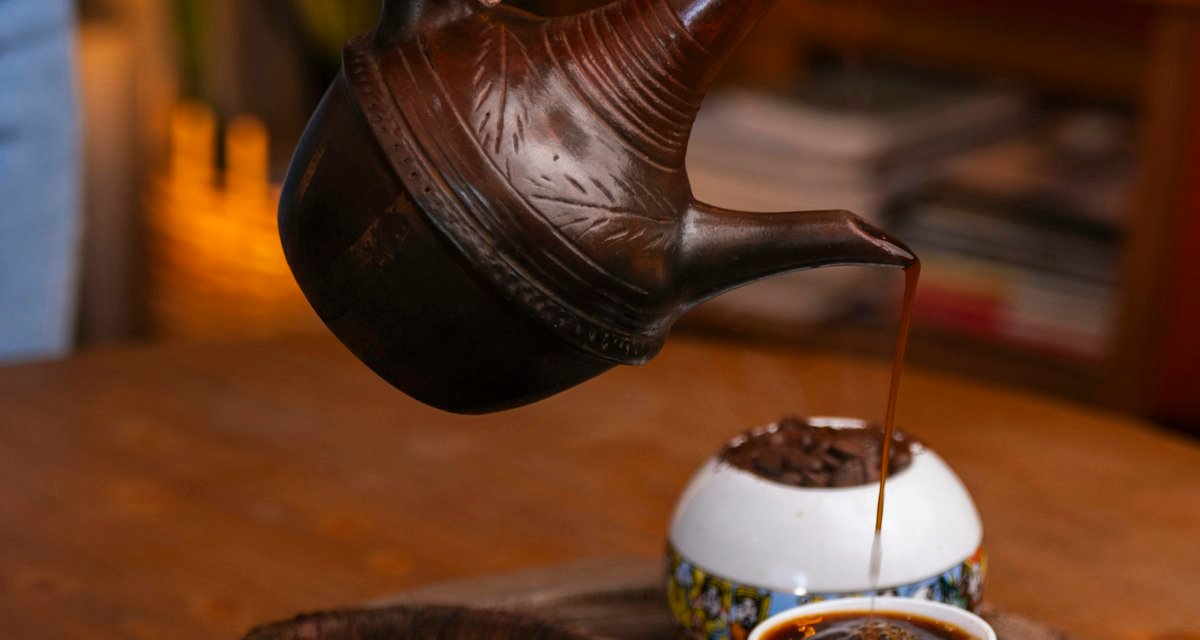
In Ethiopia, coffee (buna) can be a two-hour event. A hostess roasts green beans in a flat pan, brings the smoking pan around so guests can enjoy the aroma, grinds the beans and brews them in a jebena, a round clay pot with a long neck. Coffee comes in three rounds: abol (strongest), tona and baraka, the “blessing.” Popcorn is often passed around, and leaving early is impolite.
Turkey: Turkish coffee and fortune reading
UNESCO added Turkish coffee culture and tradition to its intangible heritage list in 2013. Powder-fine coffee is brewed slowly with cold water and sugar until foam forms, then served unfiltered in small cups with a glass of water. Afterward, the grounds left in the cup are often “read” to tell the drinker’s fortune.
Italy: the espresso bar
Italians often drink espresso standing at the counter (al banco), where it costs far less than at a table. Cappuccino is a morning drink, and ordering one after about 11 a.m. breaks an unspoken rule. The bar is a quick social stop, not a laptop office.
Sweden: fika
Fika is a break for coffee and something sweet, shared with friends or coworkers. The word likely comes from 19th-century slang that flipped the syllables of kaffi (coffee). A cinnamon bun (kanelbulle) is the classic partner.
Vietnam: cà phê sữa đá and egg coffee
Strong robusta drips slowly through a metal phin. Fresh milk was scarce and costly in the tropical heat, so sweetened condensed milk became standard, and over ice it becomes cà phê sữa đá. Hanoi’s egg coffee (cà phê trứng) dates to 1946, when bartender Nguyen Van Giang whipped egg yolk into a creamy topping during a milk shortage; his family still runs Café Giang.
Mexico: café de olla
“Coffee from the pot” is brewed in a clay olla with piloncillo (unrefined cane sugar) and cinnamon, then strained. It is tied to the Mexican Revolution, when women called soldaderas or Adelitas are said to have made it in army camps.
Cuba: cafecito
A cafecito is a small, very sweet dark-roast shot, often made in a moka pot. The secret is the espumita: the first drops of coffee are whipped with sugar into a pale foam before the rest is poured in. A colada is a bigger serving shared in tiny cups; a cortadito adds steamed milk.
Saudi Arabia and the Gulf: qahwa
UNESCO recognized Arabic coffee as a symbol of generosity in 2015, nominated jointly by Saudi Arabia, the UAE, Oman and Qatar. Coffee is boiled with cardamom (sometimes saffron or cloves) and poured from a dallah into small cups filled only about a quarter full. The most senior guest is served first, cups are held in the right hand, and dates are a classic companion.
Greece: frappé
Instant coffee shaken with cold water, sugar and ice makes the foamy frappé. The popular story credits Nestlé employee Dimitris Vakondios at the 1957 Thessaloniki International Fair, though earlier Nestlé ads suggest the drink may predate him. Either way, it is a Greek summer staple.
Finland: the biggest coffee drinkers
Finland regularly tops per-person consumption rankings. Finns favor light-roast filter coffee, often black, and twice-daily workplace coffee breaks (kahvitauko) are part of working life.
India: South Indian filter coffee
Legend says the Sufi saint Baba Budan smuggled seven coffee seeds from Yemen to Karnataka’s Chikmagalur hills. Today “filter kaapi” drips from a two-chamber metal filter, often with chicory in the blend, then is mixed with hot milk and sugar and poured between a tumbler and a dabara to cool and froth.
Ireland: Irish coffee
The Foynes Flying Boat Museum credits chef Joe Sheridan with inventing Irish coffee in 1943 for cold passengers on a returned transatlantic flight, though some historians think it is older. San Francisco’s Buena Vista Cafe recreated it on November 10, 1952, and it took off in the US. The recipe: hot coffee, sugar, Irish whiskey and cold cream floated on top.
Japan: kissaten and canned coffee
Japan’s first coffeehouse, Kahiichakan, opened in Tokyo in 1888, inspired by London coffeehouses, and the idea grew into the kissaten, quiet cafés known for careful hand-brewed coffee. Japan also pioneered convenience: UCC sold the first canned coffee in 1969, and Pokka introduced hot-and-cold vending machines in 1973.
Austria: the Viennese café
Viennese coffeehouses are made for lingering. Coffee arrives on a small silver tray with a glass of water, and the Wiener Melange, topped with milk foam, is the house classic.

How to brew coffee: 10 methods compared
These recipes are common starting points drawn from National Coffee Association guidance and standard specialty practice. A ratio like 1:16 means 1 gram of coffee to 16 grams (ml) of water. Most hot methods work best with water around 195 to 205°F (90 to 96°C). If coffee tastes sour or thin, grind finer; if it tastes bitter or harsh, grind coarser.
An even burr grind matters more than almost anything else. See our guide to the best coffee grinders if you are upgrading.
1. Drip coffee machine
A drip machine showers hot water over grounds in a filter and drips coffee into a carafe. It is the easiest way to make several cups, with a clean, medium body. Good machines reach proper brewing temperature and wet the grounds evenly.
Starting recipe: 1:15 to 1:17 (or 1 to 2 tablespoons per 6 oz water), medium grind, about 5 minutes. Best for: busy households.
2. Pour-over (Hario V60 / Kalita Wave)
You pour water by hand through grounds in a dripper, controlling speed and flow. That control brings out the bright, delicate flavors of light roasts. The V60’s single large hole is fast and responsive; the flat-bottom Kalita Wave is more forgiving.
Starting recipe: 1:15 to 1:16, medium-fine grind, about 200°F (93°C), bloom with twice the coffee’s weight in water for 30 to 45 seconds, 2.5 to 3.5 minutes total. Best for: single cups and light roasts.
Representative pick: Hario V60 dripper. Shop on Amazon →
3. Chemex
Patented by chemist Peter Schlumbohm in 1941 and held in the Museum of Modern Art’s collection, the Chemex is an hourglass glass brewer. Its thick paper filters catch more oils and fines, giving a very clean, tea-like cup. It suits brewing for two or more.
Starting recipe: 1:15 to 1:17, medium-coarse grind, about 200°F (93°C), 4 to 5 minutes. Best for: clean, bright coffee for a few people.
Representative pick: Chemex 6-cup classic. Shop on Amazon →
4. French press
Coarse grounds steep in hot water, then a mesh plunger pushes them down. The mesh lets oils through, so the coffee is rich and heavy-bodied with a little sediment. It is very forgiving and great with chocolatey or earthy beans.
Starting recipe: 1:12 to 1:15, coarse grind, about 200°F (93°C), steep 4 minutes, then press slowly. Best for: full-bodied coffee with minimal fuss.
Representative pick: Bodum Chambord French press. Shop on Amazon →
5. AeroPress
Invented by engineer Alan Adler and launched in 2005, the AeroPress pairs a short steep with gentle air pressure through a paper filter. The cup is smooth, clean and low in bitterness, and the brewer is light and durable.
Starting recipe: about 15 g coffee to 230 to 250 g water, medium-fine grind, 175 to 200°F (80 to 93°C), about 2 minutes, then press. Best for: travel and single cups.
Representative pick: AeroPress Original. Shop on Amazon →
6. Moka pot
Alfonso Bialetti’s stovetop moka pot dates to 1933. Steam pressure in the bottom chamber pushes water up through the grounds into the top. The coffee is strong and intense, between drip and espresso, though not true espresso.
Starting recipe: fill the basket level without tamping, water just below the valve (preheated helps), fine-medium grind, medium-low heat, remove when it starts to sputter, about 4 to 5 minutes. Best for: strong coffee and Cuban-style cafecito.
Representative pick: Bialetti Moka Express. Shop on Amazon →
7. Espresso
Espresso forces hot water at high pressure through a packed puck of fine coffee, producing a small, concentrated shot with crema. It is the base for lattes and cappuccinos, and the most demanding method: grind, dose and timing all need dialing in.
Starting recipe: 1:2 (for example 18 g coffee to 36 g espresso), fine grind, 25 to 30 seconds. Best for: milk drinks and hobbyists. See our guide to the best espresso machines for home.
8. Cold brew
Coarse grounds steep in cold or room-temperature water for many hours. Without heat, the result is smooth, mellow and low in acidity. Most recipes make a concentrate to dilute with water, milk or ice.
Starting recipe: 1:4 to 1:5 for concentrate (about 1:8 to drink straight), coarse grind, 12 to 18 hours, then filter and refrigerate. Best for: summer and make-ahead coffee.
Representative pick: Hario Mizudashi cold brew pot. Shop on Amazon →
9. Turkish coffee (cezve)
Powder-fine coffee, cold water and optional sugar heat slowly in a small long-handled cezve until a thick foam rises. It is served unfiltered, so let the grounds settle first. Expect a thick, intense cup; cardamom is a popular addition.
Starting recipe: 1 heaping teaspoon (about 7 g) per demitasse of cold water (about 2 to 2.5 oz), low heat for 2 to 3 minutes, remove before it boils. Best for: ritual and a small, powerful cup.
Representative pick: a copper cezve. Shop on Amazon →
10. Vietnamese phin
The phin sits on top of your cup and drips slowly through a compact bed of grounds, making a short, strong, dark coffee. Pour it over condensed milk and ice for cà phê sữa đá; dark-roast robusta tastes most authentic.
Starting recipe: about 2 tablespoons (15 to 20 g) medium-coarse coffee, a splash of hot water to bloom for 30 seconds, then fill and drip 4 to 5 minutes over 1 to 2 tablespoons of condensed milk. Best for: sweet iced coffee fans.
Representative pick: a Vietnamese phin filter. Shop on Amazon →
Brewing methods compared
| Method | Grind | Ratio | Time | Body / taste | Difficulty |
|---|---|---|---|---|---|
| Drip machine | Medium | 1:15–1:17 | ~5 min | Clean, medium body | Easy |
| Pour-over | Medium-fine | 1:15–1:16 | 2.5–3.5 min | Bright, nuanced | Medium |
| Chemex | Medium-coarse | 1:15–1:17 | 4–5 min | Very clean, light | Medium |
| French press | Coarse | 1:12–1:15 | 4 min | Rich, heavy | Easy |
| AeroPress | Medium-fine | ~1:15–1:16 | ~2 min | Smooth, low bitterness | Easy |
| Moka pot | Fine-medium | Fill basket | 4–5 min | Strong, intense | Medium |
| Espresso | Fine | 1:2 | 25–30 sec | Concentrated, crema | Hard |
| Cold brew | Coarse | 1:4–1:8 | 12–18 hrs | Smooth, low acidity | Easy |
| Turkish cezve | Powder-fine | ~1:9–1:10 | 2–3 min | Thick, unfiltered | Medium |
| Vietnamese phin | Medium-coarse | ~1:5–1:6 | 4–5 min | Strong, bold | Easy |
Tip: Brewed coffee is mostly water, so use fresh, cold, filtered water with no chlorine taste, and skip distilled or softened water. Buy whole beans you will finish within a week or two, store them in an airtight, opaque container somewhere cool and dark, and grind right before brewing. Freeze only for longer storage, in sealed portions you will not refreeze.
FAQ
Where did coffee originate?
The coffee plant is native to Ethiopia’s highlands, and the first coffee drinks and farms appeared across the Red Sea in Yemen by the 15th century. The Kaldi story is a legend.
Which country produces the most coffee?
Brazil, which grows about a third of the world’s coffee. Vietnam, mostly robusta, is second, and Colombia is among the next-largest producers.
What is the strongest brewing method?
By concentration, espresso, at about 1 part coffee to 2 parts water. By caffeine per serving, a mug of drip often wins: Mayo Clinic lists about 96 mg in 8 oz of brewed coffee versus about 63 mg in a 1 oz espresso. Turkish coffee, moka pot coffee and undiluted cold brew concentrate are also very strong.
Does light roast have more caffeine than dark roast?
Only if you measure by the scoop. Dark-roast beans are less dense, so a scoop of light roast holds a bit more coffee. Gram for gram, the difference is negligible; bean species and serving size matter much more.
Which country drinks the most coffee?
Per person, Finland usually tops the rankings, with Finns drinking several cups a day on average.
Related guides
- All coffee buying guides
- The best espresso machines for home
- Breville Bambino Plus vs Barista Express
- The best coffee subscriptions
- The best coffee roasters across the USA
- The best coffee grinders
Sources
National Coffee Association: History of coffee · Britannica: History of coffee · NCA: Coffee varieties · NCA: Coffee regions of the world · NCA: Coffee processing · NCA: Drip coffee · NCA: Pour-over · NCA: French press · NCA: Espresso · NCA: Cold brew · NCA: Storage and shelf life · Specialty Coffee Association: Coffee Standards · UNESCO: Turkish coffee culture and tradition · UNESCO: Arabic coffee, a symbol of generosity · Abu Dhabi Culture: Gahwa · Historic UK: English coffeehouses · Austria Tourism: Viennese coffeehouse culture · Modern Farmer: The coffee spies · INeedCoffee: History of instant coffee · History Oasis: Ways we invented to brew coffee · Gaggia: History · Bialetti (Wikipedia) · Lemelson-MIT: Peter Schlumbohm · AeroPress: About · Third-wave coffee (Wikipedia) · Coffee Review: Great Lakes coffees · Sweet Maria’s: Sumatra overview · Coffee production in India (Wikipedia) · Kona coffee (Wikipedia) · California Farm Bureau Ag Alert: Specialty coffee in Southern California · Barista Magazine: Ethiopian coffee ceremony · Compassion International: Ethiopian coffee ceremony · Reach the World: Italian coffee bars · Nordic Visitor: Fika · Vietnam Tourism: Coffee culture · Mental Floss: Vietnamese egg coffee · Mexicanist: Café de olla · The Manual: Cuban coffee · Britannica: Mocha, Yemen · Britannica: Café cubano · Frappé coffee (Wikipedia) · Islands: Finland coffee culture · Homegrown: Origins of filter coffee · KQED: History of Irish coffee · Japan House LA: Coffee in Japan · Web Japan: Canned coffee · Caffè Vergnano: Turkish coffee method · Caffeine Informer: Roast and caffeine · JavaPresse: Pacific coffee origins · Arab News: Saudi coffee · Mayo Clinic: Caffeine content. Photos courtesy of Unsplash.